

Moroccan Greek Tortoise Care Guide: A Dry-Climate Mediterranean Tortoise
The Moroccan Greek tortoise is a compact, sun-loving tortoise from the dry hills of northwest Africa. It shares a family tree with other Greek tortoises, but it is built for a more arid climate than many of its cousins and stays a comfortable size for a well-planned indoor table or a secure outdoor pen. This guide explains how to keep one healthy and introduces the Moroccan Greek tortoises you can meet at www.TortoiseTown.com.
Natural History
Moroccan Greek tortoises belong to the Greek tortoise complex, Testudo graeca. The Moroccan form, often associated with Testudo graeca graeca, lives in Morocco and neighboring parts of Algeria. It occupies open, well-drained hillsides, coastal scrub and dry woodland where sunlight is strong, rainfall is seasonal and vegetation is tough and aromatic rather than lush.
In that landscape the tortoise spends warm mornings foraging on weeds, wildflowers and dry grasses, then retreats under shrubs, rocks or a shallow scrape during the hottest part of the day. Winters can be cool enough that animals reduce activity for a time, so keepers in temperate regions should plan for a safe seasonal rest or a consistently warm indoor setup rather than exposing a tortoise to damp, freezing weather.
Appearance
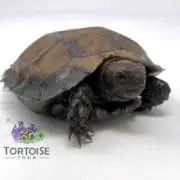
These tortoises typically have a high-domed carapace in gold, tan or olive, often with darker pigment along the scute seams. The head and forelegs are usually a warm yellow to golden tone, and the scales on the front legs are prominent. Compared with some heavier-bodied Greek forms, Moroccan animals often look a little finer-boned and more compact, with a neatly rounded shell.

Males are usually smaller than females, with a longer, thicker tail and a slightly concave plastron. Females have a shorter tail and a flatter underside. Hatchlings show the same golden tones in miniature and darken or contrast more as they grow.
Size and Lifespan
Hatchlings are only a couple of inches long. Most adults reach about 5 to 8 inches in shell length, which is smaller than many Ibera or golden Greek adults. With steady care they can live 50 years or more, so this is a long-term companion rather than a short project.
Temperament
Moroccan Greeks are alert, curious and strongly food-motivated. Many learn the routine of their enclosure and come walking out when they see their keeper. They are not cuddly animals, and they prefer to explore at ground level rather than be held, but they settle well when their heat, light and diet are consistent. Males may become territorial if kept together, so watch for ramming or persistent following and house animals separately if tension appears.
Enclosure Setup
A tortoise table or a custom wooden enclosure with solid sides works far better than a glass aquarium. Young animals do well in a footprint of about 4 by 2 feet, and adults appreciate still more floor space. In warm, dry climates a secure outdoor pen with buried barriers, shade and a dry hide is ideal for at least part of the year.

- Use a dry, well-drained substrate such as a soil and play-sand mix, or a sandy loam that will not stay soggy.
- Offer a dry hide on the warm side and a slightly more humid hide with moss for hatchlings, so they can choose their microclimate.
- Provide a shallow water dish that is easy to enter and exit, cleaned daily.
- Add low stones, cork and sturdy plants for security and gentle climbing, without creating drop-off hazards.
If you are comparing Mediterranean forms, the slightly larger Golden Greek tortoise and the Ibera Greek tortoise share a similar husbandry outline but often want a bit more space as adults.
Heat, UVB and Humidity
Give these tortoises a clear temperature gradient. Aim for a basking area of about 95°F, with the rest of the enclosure in the mid 70s to mid 80s during the day. Night temperatures can drop into the mid 60s. A quality linear UVB tube should cover a large portion of the enclosure, with shaded spots so the tortoise can move in and out of the light.
Humidity should stay moderate, not tropical. Soaking a hatchling in shallow warm water a few times a week supports hydration, but the main enclosure should dry quickly after any misting. Constantly wet substrate is a common cause of shell and respiratory problems in this arid-adapted form.
Diet
Moroccan Greeks are grazers. The diet should be high in fiber, high in calcium and low in protein and sugar:

- Broadleaf weeds such as dandelion, plantain, sow thistle, clover and hawkbit
- Tortoise-safe flowers and leaves, including hibiscus, mulberry and rose
- Grasses and grass hay as a daily fiber source
- Occasional endive, escarole, squash or cactus pad as variety
Avoid fruit except as a rare taste, and skip cat or dog food, legumes in quantity and pale grocery lettuces as a staple. Dust food with calcium several times a week, and keep a cuttlebone in the enclosure.
Handling
Pick the tortoise up only when needed, supporting the whole body with both hands under the plastron. Keep it low to the ground and return it promptly. Wash your hands before and after any contact.
Why Captive-Bred Animals Matter
Wild Greek tortoises face habitat loss and collection pressure across much of their range. Captive-bred Moroccan Greeks start life on a proper diet with the right light and humidity, and they are already accustomed to people. The Moroccan Greek tortoises at www.TortoiseTown.com are a thoughtful way to enjoy this dry-country species without drawing on wild populations.
Frequently Asked Questions
How is a Moroccan Greek different from other Greek tortoises?
It is generally a smaller, more arid-adapted form with warm golden tones. Housing should stay drier than the setup many keepers use for heavier, more temperate Greek lines.
Do Moroccan Greek tortoises hibernate?
In nature they may slow down during cool months. Only healthy, well-conditioned animals should be given a carefully controlled brumation, and many keepers simply keep them active indoors through winter.
How big do they get?
Most adults reach 5 to 8 inches, which is modest compared with many other Greek tortoise forms.
Can they live outdoors?
Yes, in a secure, well-drained pen when weather is warm and dry, with shade, a hide and protection from predators and damp cold.
Meet our captive-bred Moroccan Greek tortoises at www.TortoiseTown.com.


Leave a Reply
Want to join the discussion?Feel free to contribute!