

Reeve’s Turtle Care Guide: A Hardy Asian Pond Turtle
Reeve’s turtle is a compact, dark-shelled Asian pond turtle that has earned a quiet reputation as a sturdy, personable aquatic species. It does not need a giant outdoor pond to thrive, but it does need clean water, a proper basking dock and a mixed diet. This guide covers the essentials and the Reeve’s turtles at www.TortoiseTown.com.
Natural History
Reeve’s turtle, Mauremys reevesii, is native to parts of China, the Korean Peninsula and Japan, with a long history in ponds, rice fields, slow rivers and marshy edges. It is a versatile freshwater turtle that hauls out on banks and logs, forages in shallow water and can be quite active in warm weather. In some regions wild populations have declined, which makes captive-bred stock especially important.
It belongs to a group of Old World pond turtles that also includes animals such as the Japanese pond turtle and the strikingly lined Chinese golden thread turtle. Those species share a broadly similar need for clean freshwater and a dry basking site, though adult size and markings differ.
Appearance
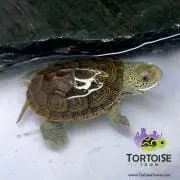
The carapace is usually olive, brown or nearly black, sometimes with three low keels down the back, especially in younger animals. The skin is dark with finer pale striping on the head and neck. The plastron may show dark blotches on a lighter ground. Males are typically smaller, with a longer, thicker tail and a slightly concave plastron. Females grow broader and heavier. Hatchlings are already unmistakably little pond turtles, with sharper keels and fresher contrast.

Size and Lifespan
Adults commonly reach about 6 to 9 inches, a comfortable size for a serious indoor aquatic setup. They are long-lived for their size; 20 to 30 years is realistic, and some animals live longer still when water quality stays high.
Temperament
Reeve’s turtles are often described as confident once they settle in. They learn feeding times, use the dock predictably and will swim over to investigate a keeper. They can be assertive with tankmates, so housing is usually simplest one turtle at a time unless you have a very large, complex system and can watch for bullying. They are not lap animals; brief, supported handling for health checks is enough.
Enclosure Setup
A spacious aquarium or stock-tank style habitat is the core of good care. For an adult, 40 gallons is a bare minimum and 75 gallons is more comfortable, with a water depth that lets the turtle swim freely and a dry platform that is easy to climb. Include:

- A sturdy basking dock under heat and UVB
- A filter rated well above the tank’s volume
- A heater, a tight lid and smooth decor without sharp edges
- Optional plants or visual barriers so the turtle has a sense of cover
A bare bottom or fine sand makes cleaning easier than coarse gravel. These turtles will eat in the water, so a weekly maintenance rhythm of water changes, filter care and dock scrubbing keeps the habitat healthy.
Heat, UVB and Water Quality
Keep the water around 72 to 78°F and the basking surface near 85 to 90°F. Room-temperature water that stays too cool leads to poor appetite and a turtle that never fully dries out. A UVB lamp should reach the dock directly. Good filtration is not a substitute for partial water changes; test the water and stay ahead of ammonia and nitrite, especially while the system is new or the turtle is growing fast.
Diet
Reeve’s turtles are omnivores. A practical menu includes:

- A high-quality aquatic turtle pellet as a reliable base
- Leafy greens such as dandelion, escarole or other turtle-safe produce
- Earthworms, snails and occasional insects or fish for variety
Juveniles often take more animal food; adults usually accept a greater share of plant matter. Dust occasional feeder items with calcium, and avoid a steady diet of only fatty feeder fish.
Handling
Lift the turtle with both hands around the shell, well above the water, and return it promptly. Wash your hands afterward. When doing tank work, move the turtle to a secure temporary tub so it cannot flip off a dock or fall to the floor.
Captive-Bred Pond Turtles
Captive-bred Reeve’s turtles begin life eating prepared foods and living in clean, warm water, which is a much easier start than rehabilitating a stressed wild animal. The Reeve’s turtles at www.TortoiseTown.com are a good fit for keepers who want an Asian pond turtle in a well-filtered freshwater habitat.
Frequently Asked Questions
Is a Reeve’s turtle a good first aquatic turtle?
It can be, provided you are ready for a large filtered tank, UVB, regular water changes and a long-lived animal. It is more compact than a big slider, but it is not a desk pet.
How large do they get?
Most adults reach 6 to 9 inches, with females usually larger than males.
Can they live with fish?
Some fish may be eaten, and all fish add to the bioload. A species-only tank is the simplest, cleanest approach.
Do they need land?
They need a dry, warm basking site every day, even though they spend most of their time in the water.
Meet our captive-bred Reeve’s turtles at www.TortoiseTown.com.


Leave a Reply
Want to join the discussion?Feel free to contribute!