

Yellow-Bellied Slider Care Guide: Habitat, Basking and Diet
The yellow-bellied slider is a bright, active freshwater turtle with a golden plastron and a clean yellow blotch behind each eye. It is closely related to the familiar red-eared slider, and it needs the same generous aquatic setup: deep water, a high basking dock, strong filtration and a diet that shifts toward plants with age. This guide covers that care and the yellow-bellied slider turtles at www.TortoiseTown.com.
Natural History
The yellow-bellied slider, Trachemys scripta scripta, is a subspecies of the pond slider native to the southeastern United States, especially river systems and wetlands of the Carolinas, Georgia and Florida and neighboring areas. It basks in stacks on logs, slips into warm shallows to feed and can wander over land between bodies of water after rain.
It is the regional counterpart of the red-eared slider turtle, which shows a red or orange stripe behind the eye rather than a yellow patch. Other sliders and slider-like pond turtles, including the red-bellied slider turtle, share the same broad need for space and sunlight. In the wild, sliders are opportunistic omnivores, taking plants, insects, carrion and whatever else the water offers.
Appearance
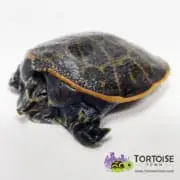
The carapace is olive to brown with yellow markings, and the plastron is distinctly yellow, often with small dark smudges. The most helpful field mark is a broad yellow blotch or bar behind the eye, rather than a red slash. The skin is striped in yellow and green-black. Females grow larger and deeper than males. Males develop longer front claws and a longer, thicker tail, and they may darken with age. Hatchlings are neon-bright and almost circular, then lengthen as they grow.

Size and Lifespan
Males often mature around 5 to 8 inches. Females commonly reach 8 to 13 inches. That adult size is why a small kit aquarium is only a short nursery, not a home. With consistent care, yellow-bellied sliders can live 20 to 40 years, and many well-kept animals live longer, so this is a long friendship rather than a season-long project.
Temperament
These are bold, busy, hungry turtles. They will paddle at the glass, pile onto the dock the moment the basking lamp warms up and learn who brings food. They can be competitive if housed together, and they may nip during feeding. They are delightful to watch and only occasionally, carefully handled.
Enclosure Setup
Plan for a large aquatic habitat. A 75-gallon tank is a practical starting point for one growing slider, and an adult female is more comfortable in a 100-gallon class setup, a stock tub or an outdoor pond in a suitable climate. Include:

- A dry, sturdy basking dock that lets the turtle haul out completely
- A filter rated for well above the tank’s volume
- A heater, a tight lid and a water depth that allows real swimming
- Smooth decor and an easy ramp, without stacks that can collapse
Outdoors, a pond needs sun, deep water, a dry basking log, an escape-proof barrier and a way for the turtle to get out if water levels drop. Indoor keepers should budget time for weekly water care, because sliders are enthusiastic mess-makers.
Heat, UVB and Lighting
Keep the water around 75 to 80°F and the basking surface around 90 to 95°F. A quality UVB lamp must shine directly on the dock; glass lids block much of the useful light, so place the fixture on a screen or an open fixture above the bask site. A day-night schedule of about 12 hours of light helps keep the turtle’s routine steady. If the turtle never fully dries on the dock, lower the water line slightly or improve the ramp rather than turning the heat up without a better platform.
Diet
Hatchlings and juveniles eat a more protein-rich diet. As the turtle matures, plant food should become a bigger share of the menu:

- A staple of high-quality aquatic turtle pellets
- Leafy greens such as dandelion, romaine in moderation, escarole and aquatic plants
- Occasional worms, insects or fish, more often for young animals than for adults
Calcium matters for shell growth. Avoid a steady diet of only treats, and take out uneaten food so the water stays clear.
Handling
Support the turtle’s shell with both hands, keep it over a towel or the tank, and wash your hands afterward. Limit handling to health checks and habitat work. These turtles are strong swimmers and can also walk farther on land than people expect, so never leave one loose unattended.
Captive-Bred Sliders
Captive-bred yellow-bellied sliders are already started on appropriate foods and do not need to be taken from wild waterways, where native populations have their own pressures. The yellow-bellied slider turtles at www.TortoiseTown.com are a classic, active aquatic turtle for keepers who can offer a large, clean, well-lit setup.
Frequently Asked Questions
How is a yellow-bellied slider different from a red-eared slider?
They are closely related subspecies. The yellow-bellied form has a yellow blotch behind the eye and a very yellow plastron; care is essentially the same.
How large a tank do I need?
Think large from the start. A 75-gallon aquarium is a working minimum for one growing turtle, and adult females appreciate still more space or an outdoor pond.
Do adults still need protein?
Some, but not as a majority of the diet. Shift toward greens and pellets as the turtle grows.
How long do they live?
Several decades is normal with clean water, proper lighting and a thoughtful diet.
Meet our captive-bred yellow-bellied slider turtles at www.TortoiseTown.com.


Leave a Reply
Want to join the discussion?Feel free to contribute!