

Diamondback Terrapin Care Guide: A Brackish-Water Coastal Turtle
The diamondback terrapin is a coastal turtle with a sculpted, concentrically ringed shell and a lifestyle that does not match a typical freshwater slider tank. It comes from salt marshes and tidal creeks, and it does best when keepers respect that brackish world. This guide explains the setup and introduces the diamondback terrapins at www.TortoiseTown.com.
Natural History
Diamondback terrapins, Malaclemys terrapin, live along the Atlantic and Gulf coasts of the United States, from Massachusetts to Texas, in salt marshes, estuaries and mangrove edges. They move with the tides, forage on mollusks and crustaceans, and haul out on banks, wrack and oyster bars to bask. Several regional forms exist, and the patterned concentric diamondback terrapin is especially prized for the tight, carved rings on each scute.
Because they occupy a narrow coastal band, terrapins are sensitive to habitat loss, road mortality near nesting beaches and past commercial harvest. Captive-bred animals let keepers enjoy the species without adding pressure to wild marshes.
Appearance
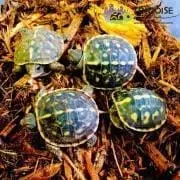
The carapace is gray, olive or nearly black, often with bold concentric grooves and flecking that give the diamondback its name. The skin is pale with dark speckles, and the hind feet are strongly webbed. Females grow much larger than males and have broader heads, an adaptation for crushing snails and crabs. Males stay smaller, with longer, thicker tails. Hatchlings are already distinctively patterned and grow quickly in a warm, clean system.


Size and Lifespan
Males often mature around 4 to 5 inches. Females commonly reach 6 to 9 inches, sometimes a little more. A tank plan should assume a female’s adult size even if you start with a small hatchling. With good water quality and diet, terrapins can live several decades, often 25 to 40 years or more.
Temperament
These are alert, hungry, aquatic turtles. They notice movement at the glass, learn feeding stations and can be quite bold once settled. They are not turtles for constant handling; they belong in the water, and they can be quick with the jaws when they think fingers are food. A secure lid is important, because a motivated terrapin will climb filter intakes and decorations.
Brackish Enclosure Setup
Plan an aquatic habitat with a generous water area and a sturdy dry haul-out. A 75-gallon tank or larger is a reasonable adult target for a single female, and bigger is better for water quality. Include:
- A basking dock that stays dry and is easy to climb
- A strong filter rated well above the tank volume, because brackish water and a protein-rich diet produce waste quickly
- A mixed substrate of fine sand or a bare bottom for easy cleaning; avoid sharp gravel that can injure the shell
- A tight-fitting lid and good lighting above the dock
Salinity is the feature that sets terrapins apart. Many keepers maintain moderately brackish water, often around 1.010 to 1.020 specific gravity, using a marine salt mix and a hydrometer or refractometer. Some systems offer a slightly fresher area as well. What you should not do is keep a diamondback indefinitely in hard, untreated freshwater the way you might keep a musk turtle. Sudden, extreme salinity swings are also stressful, so make changes gradually and keep a regular testing routine.
Heat, UVB and Water Quality
Water temperatures in the mid to upper 70s°F, with a basking area of about 85 to 90°F, work well. Use a submersible heater rated for the salinity you maintain, and check it often. A UVB lamp should shine on the dry dock, not through a thick glass lid that blocks the useful wavelengths.
Do partial water changes on a schedule, siphon waste and watch ammonia, nitrite and nitrate. Brackish does not mean less maintenance. If the water smells sour or the turtle’s skin looks neglected, the system needs more filtration or more frequent changes.
Diet
Diamondback terrapins are naturally heavy on mollusks and crustaceans. In an enclosure they thrive on:

- Snails, clams, shrimp and similar shelled or crustacean foods
- High-quality aquatic turtle pellets as a staple
- Occasional fish or earthworms for variety
- Some leafy greens, which many adults will nibble
Offer a diet that includes calcium-rich items so the shell stays strong, and feed in a way that does not spoil the whole tank. Juveniles eat daily; adults can move to a slightly less frequent schedule.
Handling
Net or lift the turtle only for health checks or tank work, supporting the shell securely and keeping fingers away from the face. Rinse salt water off your hands and tools, and wash thoroughly afterward.
Captive-Bred Terrapins
A well-started, captive-bred terrapin is already eating prepared foods and is a better match for enclosure life than a wild marsh animal. The diamondback terrapins at www.TortoiseTown.com are a strong choice for keepers ready to maintain a clean brackish system.
Frequently Asked Questions
Can I keep a diamondback terrapin in plain freshwater?
Long-term freshwater housing is not ideal. These turtles are adapted to brackish coastal water, and a stable, moderately saline system is the better match.
Why are females so much larger than males?
It is normal sexual dimorphism. Females also tend to have broader heads for crushing hard-shelled prey.
How large a tank do I need?
Think in terms of a large aquatic setup, often 75 gallons or more for an adult female, with a dry basking dock and strong filtration.
What is a concentric diamondback?
It is a particularly well-ringed shell pattern in the same species, with deep, regular grooves on the scutes.
Meet our captive-bred diamondback terrapins at www.TortoiseTown.com.



Leave a Reply
Want to join the discussion?Feel free to contribute!