

Common Musk Turtle Care Guide: The Compact Stinkpot Explained
The common musk turtle, often called a stinkpot, is one of the most practical aquatic turtles a careful keeper can choose. It stays small, spends its days walking the bottom and exploring decor, and fits a serious aquarium far more reasonably than a turtle that will grow as wide as a dinner plate. This guide covers its care and the common musk turtles at www.TortoiseTown.com.
Natural History
The common musk turtle, Sternotherus odoratus, ranges widely across much of the eastern United States and into parts of southeastern Canada. It inhabits lakes, ponds, canals and slow rivers, often in places with mud, fallen leaves and plenty of underwater structure. It is a bottom-walker more than an open-water cruiser, and it may leave the water to bask or travel, especially in warm weather.

The famous musk is a defensive odor from glands along the underside of the shell. A frightened turtle may release it; a settled turtle in a clean tank rarely makes a point of it. Related small kinosternids at www.TortoiseTown.com include the colorful red-cheeked mud turtle and the tiny three-striped mud turtle, which share a love of modest tanks and messy appetites.
Appearance
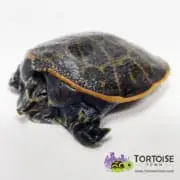
Adults have a smooth, dark, high-domed shell that can look almost black, sometimes with a lighter keel in younger animals. The head is pointed, with two light stripes on many individuals and a pair of barbels on the chin that help the turtle sense food in murky water. The plastron is reduced, leaving more soft skin visible than you see on a box turtle. Males have a longer, thicker tail and often a larger head; females are a bit more rounded. Hatchlings are tiny and dark, with a sharper keel and a lot of energy.
Size and Lifespan
This is a genuinely small turtle. Most adults reach about 3 to 5 inches, with some approaching 5 to 6 inches. Despite that modest size they are long-lived; 20 to 30 years or more is realistic. The small adult size is exactly why they are popular, but it should not be an excuse for a tiny, unfiltered bowl.
Temperament
Musk turtles are curious, food-driven and a little clumsy on land. In the water they are confident explorers. They may nip at fingers they mistake for food, and they can be shy if the tank has no places to tuck in. Once they learn a feeding routine they become outgoing in their own busy, bottom-walking way. They are not turtles that enjoy being passed around, and the musk is more likely to appear if they are handled roughly.
Enclosure Setup
A 30- to 40-gallon aquarium is a solid adult home for a single musk turtle; larger is even easier to keep stable. Water can be moderately deep, with plenty of rocks, caves and smooth wood, plus a reliable haul-out. Include:

- A small dry dock or a stack of smooth structures that breaks the surface, because they do bask, even if less dramatically than sliders
- A strong filter and a tight lid; musk turtles are surprisingly good climbers
- Fine sand or a bare bottom for easy cleaning
- Gentle flow rather than a blast that pushes a small turtle around
They will use the entire vertical space of the tank, walking over decor and surfacing to breathe. Leave open swimming lanes so the turtle is not forced through tight gaps.
Heat, UVB and Water Quality
Water in the low to mid 70s through about 78°F, with a basking area near 85°F, is a reliable range. Provide UVB over the dock. Because musk turtles eat a protein-rich diet and stir the bottom, filtration and water changes are the difference between a healthy animal and cloudy, foul water. Do not rely on a tiny internal filter meant for a betta tank.
Diet
Common musk turtles are omnivorous scavengers with a strong taste for animal food:

- Quality aquatic turtle pellets
- Earthworms, snails, bloodworms and similar moist foods
- Occasional leafy greens, which some individuals accept more readily than others
Feed modest portions that can be eaten quickly. Juveniles eat daily; adults can be fed on a slightly lighter schedule. Calcium is important, especially if the diet is short on shelled prey.
Handling
Pick the turtle up gently with two hands, keep it close to the ground or the tank, and expect it to be wriggly. Wash your hands afterward. If a defensive odor appears, it is unpleasant but harmless; return the turtle to the water and give it time to settle.
Captive-Bred Musk Turtles
Captive-bred stinkpots start life on prepared foods and adapt smoothly to a filtered aquarium. Choosing them also leaves wild pond populations where they belong. The common musk turtles at www.TortoiseTown.com are an excellent match for keepers who want a small, characterful aquatic turtle and are willing to keep the water clean.
Frequently Asked Questions
Why is it called a stinkpot?
The turtle can release a musky odor when frightened. Settled animals in a good setup do not go around scenting the room.
How big of a tank does a musk turtle need?
Plan on a 30- to 40-gallon aquarium or larger for an adult, with filtration, a dock and a lid, even though the turtle itself stays small.
Do musk turtles have to bask?
Yes. They need a dry area, heat and UVB, even if they spend most of their time underwater.
Can I keep more than one?
It is possible in a large, complex tank, but many keepers have better luck with a single turtle and no competition at feeding time.
Meet our captive-bred common musk turtles at www.TortoiseTown.com.


Leave a Reply
Want to join the discussion?Feel free to contribute!